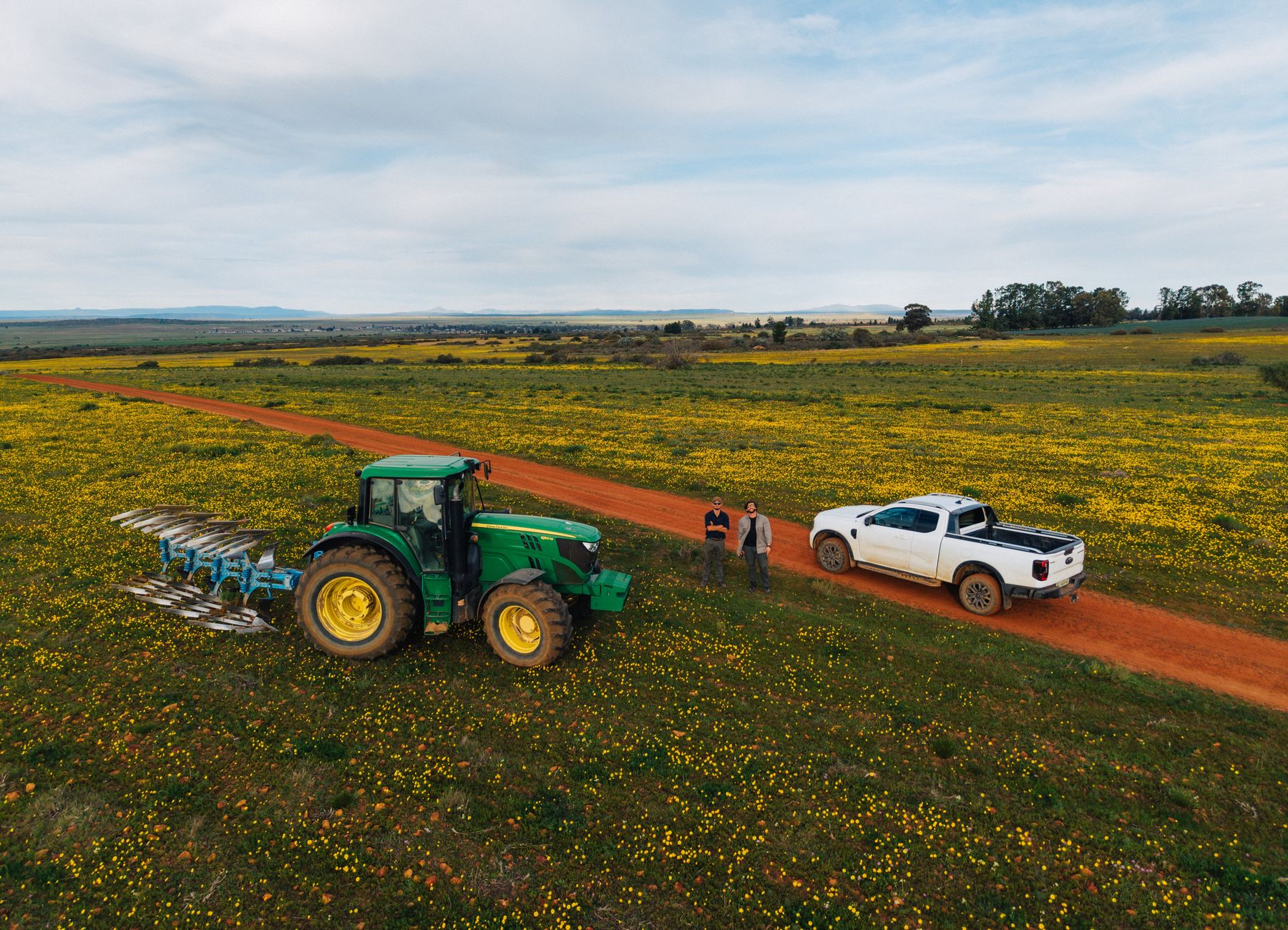
Library · Growing and making
The supply chain
A cup of rooibos is the end of a chain that starts with seed sifted from sand. This page draws the chain once and lets you read it two ways: as the physical journey of one lot of leaf, or as the work of one business role. Every stage opens a chapter with its sources.
Published 2026-10-21
The chain has a physical order and a commercial one, and they are related but not the same. The leaf moves from seed to field to court to factory to pack to shelf; the businesses that handle it overlap in ways a flow chart hides. A farm may oxidise and dry its own crop. A processor may also export and pack. A brand owner may own no factory. The explorer keeps both views honest by drawing the physical stages once and letting a role light up only the stages it performs.
The chain, drawn
Twelve stages from seed to the cup. Follow a batch through all of them, or choose a role to see only the stages that role performs. Packing can happen before or after the border: bulk leaf is packed at the destination, product packed in South Africa goes to domestic shelves or is exported and distributed as it is, and nothing exported reaches a shelf without a destination packer or distributor. A farm may process its own crop and one company can hold several roles; no company is drawn as buying from every one before it. Each stage below links to the chapter that explains it.
Producer
Grows the crop: seed, establishment, the growing stand, harvest and often the farm's own tea court. A grower may sell sheaves, oxidised and dried leaf, or finished lots.
Stages this role performs, in order:
Primary processor
Turns cut green material into dried red or green rooibos: cutting, bruising, oxidation or immediate drying, and drying. On many farms this is the producer; larger companies also offer it as a service.
Stages this role performs, in order:
Secondary processor
Receives dried lots, sieves them into fractions, removes foreign matter, blends to a specification, pasteurises, re-dries, tests and releases bulk or packed product.
Stages this role performs, in order:
Exporter and importer
Moves bulk or packed product across a border with the documents, inspection and contracts that go with it. The exporter may or may not be the producer or the processor.
Stages this role performs, in order:
Packer and brand
Fills retail packs, tea bags, blends or other products under a brand, in South Africa or overseas. The packer and the brand owner can be different companies.
Stages this role performs, in order:
Retail and brewing
Sells the packed product to the person who brews it: shops, cafés, online stores and food-service buyers in any country.
Stages this role performs, in order:
1 Seed collection and preparation every batch
Pods split and shed small hard-coated seed, which is gathered by sifting the sand under the plants, cleaned of debris, graded and stored until it is prepared for sowing.
- What happens
- Ripe pods release a single seed each. The Council describes most farmers collecting seed by sifting sand around the plants; an older story has early growers gathering it from ant nests.
- Inputs
- Mature flowering plants in their second season or later, dry late-summer soil, sieves and the labour to work the rows.
- Outputs
- Cleaned seed with a known purity and, ideally, a tested germination, stored dry until the next sowing season.
- People and equipment
- Farm staff with hand sieves; some growers buy seed from a seed supplier or a processor instead of collecting it.
- Timing and variability
- After flowering and pod set in late summer, in the season before the seed is sown in a nursery or a field.
- Quality decisions
- Purity, viability, seed source and whether the coat was treated. Which farm or district the seed came from matters later for the stand.
- Risks and effects
- Mixed or old seed, debris, insect-damaged seed, unknown provenance, and treatments that reduce vigour while improving germination.
- Who does it
- Producer
- What a buyer asks
- Where did the seed come from, how was it cleaned and tested, and was the coat treated in any way?
2 Establishment: direct sowing or nursery seedlings every batch
A new stand starts either from seed sown directly into the prepared field or from seedlings raised in a nursery and transplanted into the winter rains. Both routes start with seed.
- What happens
- Industry guidance describes nursery sowing around February and March and transplanting a few months later; a Suid Bokkeveld cooperative records members moving to direct seeding with scarified seed.
- Inputs
- Prepared land, seed or seedlings, winter rainfall, and the labour or planter for the chosen route.
- Outputs
- An establishing stand with a known plant population, a planting date and a record of the gaps that need filling.
- People and equipment
- The grower, a nursery if seedlings are bought in, and the planting crew; agronomic advice is local.
- Timing and variability
- Sowing in late summer for a nursery, transplanting in winter; direct sowing waits for the rains the seed needs to germinate.
- Quality decisions
- Survival after transplanting or germination in the field, root condition, weed pressure and an even population.
- Risks and effects
- Tap-root damage at transplanting, drought after planting, failed patches, weeds, and a method chosen on another district's evidence.
- Who does it
- Producer
- What a buyer asks
- Was this block direct-sown or transplanted, when, and how many plants survived the first summer?
3 Growing, cover crops and stand renewal every batch
The shrub builds a frame and a deep root system, gives no harvest in its first year, then several annual harvests before the stand is taken out and the land rests under cover before replanting.
- What happens
- A planting is cut for the first time roughly eighteen months after it starts and re-established after three to five harvests, in the Council's description. Cover between rows, wind protection and rotation crops are three different practices.
- Inputs
- Winter rain, sandy acidic soil, weed control, and cover or rotation crops such as oats or lupins where a grower uses them.
- Outputs
- A productive stand with a yield history by block, and rested land ready for the next planting.
- People and equipment
- The grower and the farm team; researchers and extension officers where a cover-crop system is being tried.
- Timing and variability
- Multi-year: establishment, several harvest years, then a rest of one or more seasons before replanting.
- Quality decisions
- Plant condition, harvest count and declining yield with age, soil cover and erosion, and the rotation record.
- Risks and effects
- Dry winters, wind erosion on bare sand, pests and disease in cover crops, and a legume cover assumed to feed the rooibos without local evidence.
- Who does it
- Producer
- What a buyer asks
- How old is the block this lot came from, how many harvests has it given, and what was the land under before it?
4 Harvest and field transport every batch
Shoots of leaf and fine stem are cut, by sickle or by a field machine, bound or loaded, and moved to a tea court. The harvest lot carries the season and year that follow the leaf to the invoice.
- What happens
- Processors describe a summer-to-autumn harvest, mostly by hand, with branches cut and bundled into sheaves. A machine that chops sheaves on the court is a different machine from a field harvester.
- Inputs
- A mature stand, cutting crews or a harvester, ties or bins, and transport to the court within the time the processor accepts.
- Outputs
- Sheaves or loose cut material, identified by block and date, at the court with a fresh mass.
- People and equipment
- Seasonal harvest crews, tractor and trailer drivers, and the court manager who schedules intake.
- Timing and variability
- Summer into autumn, once a year per stand; the wait between cutting and processing is a scheduling decision, not a published number.
- Quality decisions
- Cut height and branch selection, ground contact and sand, regrowth left on the plant, and the time the cut material waits.
- Risks and effects
- Cutting too low or too often shortens the stand's life; heat and delay affect the leaf; machinery on uneven ground damages plants and rows.
- Who does it
- Producer, Primary processor
- What a buyer asks
- When was this lot cut, by what method, and how long did it wait before cutting on the court?
5 Cutting and bruising on the court every batch
Sheaves are chopped to short lengths and bruised with water, which breaks cells and lets the plant's own enzymes meet oxygen. This is where red and green rooibos part.
- What happens
- A cutter reduces the harvested branches to a short length; bruising and watering open the cells. The next decision, oxidise or dry at once, decides the type.
- Inputs
- Fresh cut material, a cutter, water, and the court surface or equipment the processor uses.
- Outputs
- Cut, bruised, moist green material ready to be heaped for oxidation or taken straight to a dryer.
- People and equipment
- The court crew and the processor who sets the cut length and the sequence.
- Timing and variability
- Soon after the harvest arrives; cutting settings are set per processor and per intended product.
- Quality decisions
- Cut length, which becomes a grading factor later, and evenness of bruising and moisture.
- Risks and effects
- Uneven cut and moisture, contamination from the court, and a wait that lets the leaf deteriorate before the intended step.
- Who does it
- Producer, Primary processor
- What a buyer asks
- What cut length was set for this lot, and was it heaped for red or dried at once for green?
6 Red: oxidation, then drying red rooibos only
Bruised material is heaped and left while plant enzymes oxidise its compounds; the green turns red-brown and the familiar aroma forms. The heap is then spread thin to dry, usually in the sun.
- What happens
- Trade language calls this fermentation, but no culture is added: the plant's own enzymes act once cells are broken. Moisture, oxygen, temperature and time all move the result. One processor publishes its own heap duration; others differ.
- Inputs
- Cut bruised material, water, air, the court and the weather, and a decision on when to stop.
- Outputs
- Oxidised, sun-dried red rooibos with a measured moisture, as a raw lot for secondary processing.
- People and equipment
- The court manager who judges colour and aroma and decides when to turn the heap out.
- Timing and variability
- An overnight-scale heap in most descriptions, then a drying day or more; the clocks for oxidation, time since harvest and drying are separate.
- Quality decisions
- Depth of colour and aroma, evenness through the heap, and the moisture reached before the lot is stored.
- Risks and effects
- Over- or under-oxidation, mould or off-notes in a wet heap, rain on the court, and surface dryness mistaken for low moisture.
- Who does it
- Producer, Primary processor
- What a buyer asks
- How was the end of oxidation judged, and what moisture was measured before the lot went into storage?
7 Green: oxidation limited by rapid drying green rooibos only
For green rooibos the bruised material is dried immediately so that oxidation does not run. Processors describe heated dryers such as a fluid bed; the leaf keeps a greener colour and a lighter character.
- What happens
- The same cut leaf, with the heap step skipped. Rapid drying halts the enzymatic change rather than letting it develop.
- Inputs
- Cut bruised material, a dryer with heat and air movement, and a moisture target set by the processor.
- Outputs
- Dried green rooibos, a distinct product with its own specification and storage behaviour.
- People and equipment
- The processor running the dryer; green is a smaller share of production and much of it is exported.
- Timing and variability
- Immediate: the time between cutting and drying is the control, not a heap duration.
- Quality decisions
- Greenness retained, moisture reached, and stability in storage, which published work on green rooibos links to moisture uptake and water activity.
- Risks and effects
- Partial oxidation before the dryer, scorching, and treating green as red with a different name rather than as its own product.
- Who does it
- Producer, Primary processor
- What a buyer asks
- How soon after cutting was this lot dried, to what moisture, and how has it been stored since?
8 Secondary processing, cuts, blending and lot release every batch
Raw lots are accepted, sampled and cupped, sieved into size fractions, cleared of foreign matter and metal, blended to a specification, pasteurised and re-dried, tested, and released with their documents.
- What happens
- Physical fractionation on screens and sensory classification are two different decisions. Grade names belong to each processor; the sieve distribution is the comparable number.
- Inputs
- Raw red or green lots with their harvest identity, screens, magnets, a steam pasteuriser and a dryer, a laboratory and a cupping bench.
- Outputs
- Released lots by cut and specification, in bulk bags or ready for packing, with a certificate of analysis.
- People and equipment
- The secondary processor's intake, production, quality and release staff; sometimes a contract processor working for a trader.
- Timing and variability
- After the raw lot is dry; the sequence of pasteurising, re-drying and blending differs between facilities.
- Quality decisions
- Cut distribution, colour, moisture and water activity, foreign matter, microbial results, sensory profile and lot identity.
- Risks and effects
- Dust mistaken for contamination or contamination mistaken for dust, blends that drift between lots, and a release decision without a matching sample.
- Who does it
- Secondary processor
- What a buyer asks
- Which raw lots went into this blend, what is the sieve distribution, and was the sample I cupped drawn from the released lot?
9 Export and import of bulk or packed product bulk route
Most rooibos leaves South Africa in bulk bags for packing overseas; some leaves already packed. The exporter, the inspection, the documents and the importer each have their own clock, and the destination country is not necessarily where the tea is drunk.
- What happens
- Bulk bags on pallets in a container, inspected under the official export standard, travel with a specification, analysis, origin paperwork and the sale contract. Packed product follows the same route with its own labelling obligations.
- Inputs
- Released lots, packaging that protects against moisture, an export inspection, transport and the importer's requirements.
- Outputs
- A landed lot at an importer, a packer or a distributor abroad, with its identity intact.
- People and equipment
- The exporter, which may be the processor, a trader or an export entity; the inspection body; the forwarder; the importer.
- Timing and variability
- From release to departure and arrival; export approval validity, shelf life and storage terms run separately.
- Quality decisions
- Container condition, moisture in transit, document accuracy, and whether the shipped lot matches the approved sample.
- Risks and effects
- Condensation and odour in containers, wrong or missing documents, and reading a country total as a measure of consumption.
- Who does it
- Secondary processor, Exporter and importer, Packer and brand
- What a buyer asks
- Who is the exporter of record, which documents travel with this lot, and where will it be packed?
10 Destination packing and distribution everything exported, bulk or packed
Across the border the two routes meet again. Bulk leaf is filled into tea bags, packs, blends or other products under an importer's or brand owner's name; product already packed in South Africa goes into distribution as it is. Both need distribution; neither means the packed product must be repacked.
- What happens
- An importer, a contract packer or a brand owner takes the landed lot. For bulk, that is the packing step the leaf has not yet had. For packed exports, it is warehousing, labelling for the market where the law requires it, and distribution to the trade.
- Inputs
- Landed bulk bags with their lot identity, or landed finished packs with their codes; packaging materials and the destination market's labelling rules.
- Outputs
- Finished product in the destination market, under a South African or an overseas brand, with a code that should still trace back to the leaf.
- People and equipment
- Importers, contract packers, brand owners and distributors abroad; the South African exporter rarely sees this stage.
- Timing and variability
- After arrival and customs; packed shelf life is a finished-product statement that starts at filling, wherever filling happened.
- Quality decisions
- Whether the bulk lot still matches its released specification at filling, and whether a pack's origin and type claims can be documented from the paperwork that travelled with it.
- Risks and effects
- Lot identity lost at repacking, moisture taken up in a hub warehouse, and claims on an overseas pack that the South African paperwork never supported.
- Who does it
- Exporter and importer, Packer and brand
- What a buyer asks
- Was this product packed in South Africa or at the destination, by whom, and does its code trace back to the released lot?
11 Packing in South Africa: retail and private label packed route
Released leaf is filled into tea bags, loose packs, blends or other products under a brand, either for South African shelves or for export as a finished product. Packing can happen before or after export.
- What happens
- A packer fills to a specification under its own or a customer's brand. The brand owner, the packer and the processor can be one company or three.
- Inputs
- Released lots by cut, packaging materials with a moisture barrier, blend ingredients, labels, and the brand owner's specification.
- Outputs
- Finished retail units, cartons and pallets, with lot codes that still trace back to the leaf.
- People and equipment
- The packer's production and quality staff, the brand owner, and the label and packaging suppliers.
- Timing and variability
- After release and before distribution; packed shelf life is a finished-product statement, not the leaf's.
- Quality decisions
- Fill mass, bag performance for the cut, moisture barrier, label accuracy and allergen and blend control.
- Risks and effects
- Moisture uptake through poor barriers, mixed lots behind one code, and label claims the paperwork cannot support.
- Who does it
- Secondary processor, Packer and brand, Exporter and importer
- What a buyer asks
- Which lots are behind this pack code, and can the origin on the label be documented back to them?
12 Retail and brewing every batch
Shops, cafés, online stores and food-service buyers sell the packed product in South Africa and abroad, and someone brews it. What the cup is like depends on every stage before it and on the kettle.
- What happens
- Distribution to shelves and menus; blends, extracts and ready-to-drink products take their own routes. The retail value of a cup is not the grower's return: conversion, wastage, packaging, transport, tax and channel costs sit between them.
- Inputs
- Finished product, distribution, shelf space and the buyer's own brewing.
- Outputs
- A cup, and a repeat purchase if the product was consistent.
- People and equipment
- Retailers, distributors, cafés, online stores and, at the end of it, the person brewing the cup.
- Timing and variability
- Continuous; the lot code on a pack is the only link back to a harvest year.
- Quality decisions
- Consistency from pack to pack, freshness within the stated shelf life, and whether the brew matches what the label promised.
- Risks and effects
- Stale stock, inconsistent blends, and origin or type claims on a pack that the supply chain behind it cannot support with paperwork.
- Who does it
- Retail and brewing, Packer and brand, Exporter and importer
- What a buyer asks
- Which lot is this pack from, and will the next one taste the same?
Read the whole chain as text
- 1. Seed collection and preparation (every batch): Pods split and shed small hard-coated seed, which is gathered by sifting the sand under the plants, cleaned of debris, graded and stored until it is prepared for sowing.
- 2. Establishment: direct sowing or nursery seedlings (every batch): A new stand starts either from seed sown directly into the prepared field or from seedlings raised in a nursery and transplanted into the winter rains. Both routes start with seed.
- 3. Growing, cover crops and stand renewal (every batch): The shrub builds a frame and a deep root system, gives no harvest in its first year, then several annual harvests before the stand is taken out and the land rests under cover before replanting.
- 4. Harvest and field transport (every batch): Shoots of leaf and fine stem are cut, by sickle or by a field machine, bound or loaded, and moved to a tea court. The harvest lot carries the season and year that follow the leaf to the invoice.
- 5. Cutting and bruising on the court (every batch): Sheaves are chopped to short lengths and bruised with water, which breaks cells and lets the plant's own enzymes meet oxygen. This is where red and green rooibos part.
- 6. Red: oxidation, then drying (red): Bruised material is heaped and left while plant enzymes oxidise its compounds; the green turns red-brown and the familiar aroma forms. The heap is then spread thin to dry, usually in the sun.
- 7. Green: oxidation limited by rapid drying (green): For green rooibos the bruised material is dried immediately so that oxidation does not run. Processors describe heated dryers such as a fluid bed; the leaf keeps a greener colour and a lighter character.
- 8. Secondary processing, cuts, blending and lot release (every batch): Raw lots are accepted, sampled and cupped, sieved into size fractions, cleared of foreign matter and metal, blended to a specification, pasteurised and re-dried, tested, and released with their documents.
- 9. Export and import of bulk or packed product (bulk): Most rooibos leaves South Africa in bulk bags for packing overseas; some leaves already packed. The exporter, the inspection, the documents and the importer each have their own clock, and the destination country is not necessarily where the tea is drunk.
- 10. Destination packing and distribution (destination): Across the border the two routes meet again. Bulk leaf is filled into tea bags, packs, blends or other products under an importer's or brand owner's name; product already packed in South Africa goes into distribution as it is. Both need distribution; neither means the packed product must be repacked.
- 11. Packing in South Africa: retail and private label (packed): Released leaf is filled into tea bags, loose packs, blends or other products under a brand, either for South African shelves or for export as a finished product. Packing can happen before or after export.
- 12. Retail and brewing (every batch): Shops, cafés, online stores and food-service buyers sell the packed product in South Africa and abroad, and someone brews it. What the cup is like depends on every stage before it and on the kettle.
Roles and the stages they perform:
- Producer: Seed, Establish, Grow, Harvest, Cut, Red, Green.
- Primary processor: Harvest, Cut, Red, Green.
- Secondary processor: Secondary, Export, Pack.
- Exporter and importer: Export, Destination, Pack, Retail.
- Packer and brand: Export, Destination, Pack, Retail.
- Retail and brewing: Retail.
The role lens
Choose a role above, or follow these links, to see the chain from one seat. A role is what a business does to the leaf, not what kind of business it is; the directory lists named organisations with the roles their own public statements support.
- Producer: seed, establish, grow, harvest, cut, red, green. Grows the crop: seed, establishment, the growing stand, harvest and often the farm's own tea court. A grower may sell sheaves, oxidised and dried leaf, or finished lots.
- Primary processor: harvest, cut, red, green. Turns cut green material into dried red or green rooibos: cutting, bruising, oxidation or immediate drying, and drying. On many farms this is the producer; larger companies also offer it as a service.
- Secondary processor: secondary, export, pack. Receives dried lots, sieves them into fractions, removes foreign matter, blends to a specification, pasteurises, re-dries, tests and releases bulk or packed product.
- Exporter and importer: export, destination, pack, retail. Moves bulk or packed product across a border with the documents, inspection and contracts that go with it. The exporter may or may not be the producer or the processor.
- Packer and brand: export, destination, pack, retail. Fills retail packs, tea bags, blends or other products under a brand, in South Africa or overseas. The packer and the brand owner can be different companies.
- Retail and brewing: retail. Sells the packed product to the person who brews it: shops, cafés, online stores and food-service buyers in any country.
The chain on one farm
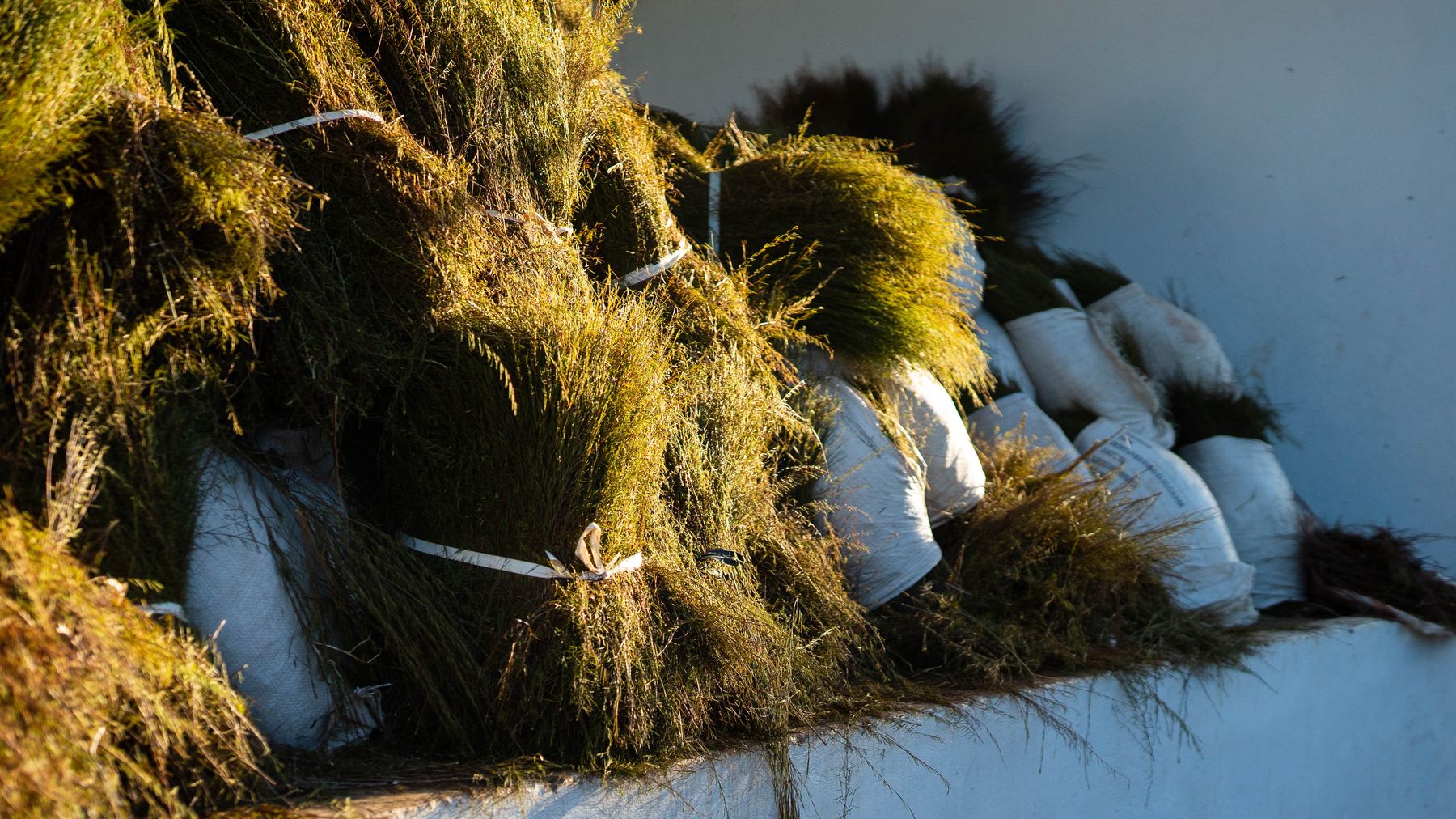
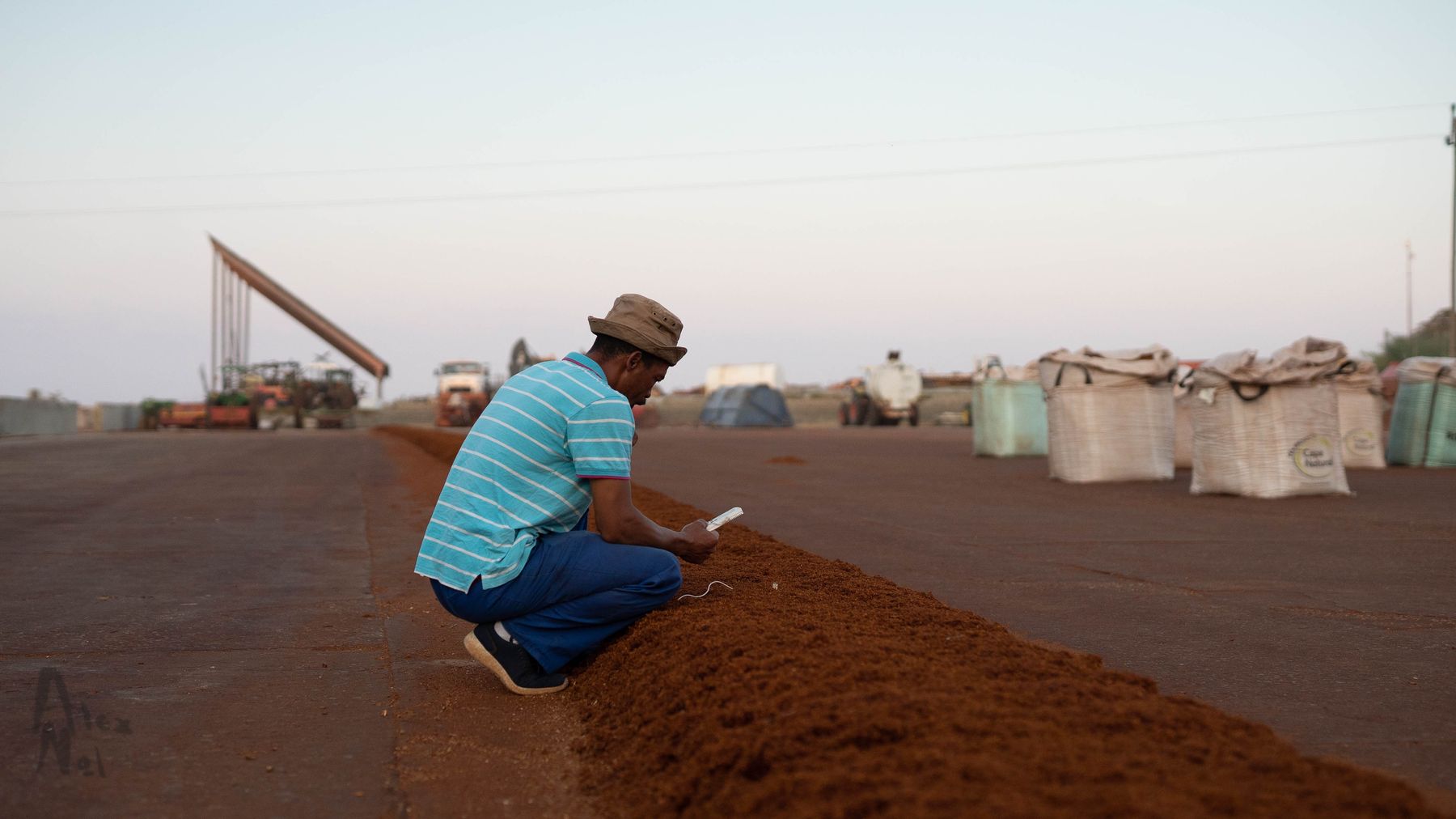
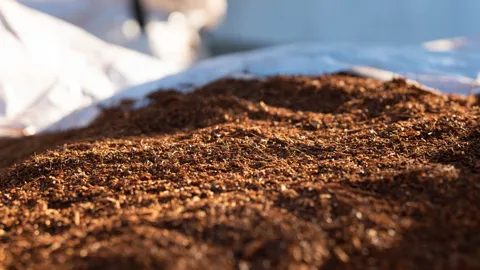
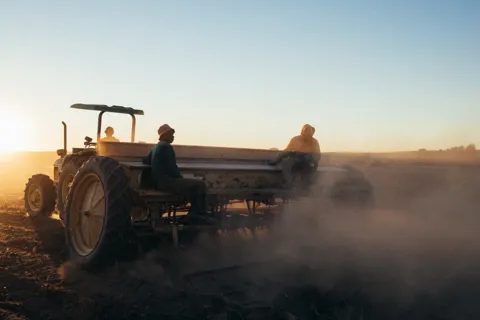
The first stages of the chain are visible on the farm that publishes this library: prepared soil between rotations, cut sheaves waiting for the court, the overnight heap turned out at sunrise and the red material spread to dry. The later stages, sieving, pasteurising, packing and the border, happen elsewhere, and the chapters describe them from processors' and the Council's own accounts rather than from photographs.
The chapters, by stage
Each stage in the explorer links to the chapter that explains it in depth, with its diagrams, photographs and source notes:
- seed and establishment: seed, establish, grow.
- growing and harvest: harvest.
- oxidation and drying: cut, red, green.
- grades and quality: secondary.
- sourcing and export: export, destination, pack.
- brewing: retail.
Two further chapters sit beside the chain rather than on it: where rooibos goes, the Council's dated export tables drawn on a chart, and who does what, a role-aware directory with every claim attributed.
What the drawing does not claim
- No company is drawn as buying from every company before it; the edges are physical, not commercial.
- No widths, volumes, shares or values are encoded in the lines. The export chapter carries the only volumes on this site, dated and sourced.
- Timings in the stage notes are the Council's and processors' descriptions, not an operating recipe; one named processor's heap duration is given in its chapter as that processor's example.
- The illustrations explain mechanisms. None is a validated process model, a measured farm or a simulation of what a particular lot will do.
How to use it when you buy
Ask the question under What a buyer asks at each stage your lot passed through. The answers, written down, are the beginning of a specification; the brief builder turns them into a document you can send to several suppliers, and the buying guide explains how to compare the replies.
Sources and notes for this page
The stage sequence follows the Council's description and two processors' own accounts; the role model is the library's own framing of who does what, checked against the company and cooperative statements in the directory. Timings in the stage notes are descriptions, not rules, and no figure for yield, cost or share appears on this page.
- SA Rooibos Council, Frequently asked questions, retrieved 2026-10-21.
- Carmién, Rooibos production and processing, retrieved 2026-10-21.
- Rooibos Ltd, About rooibos, retrieved 2026-10-20.
- Oettlé, Adaptation with a human face, 2012, retrieved 2026-10-21.
- SA Rooibos Council, Industry information sheet, 2025, retrieved 2026-10-21.
- SA Rooibos Council, Export and production outlook, 2026, retrieved 2026-10-21.
- Department of Agriculture, Rooibos export standard B8, retrieved 2026-10-20.
How sources are chosen and read is explained on the Sources and methodology page.