Library · Growing and making
Oxidation and drying
Growers call it fermentation; chemists call it enzymatic oxidation. This chapter explains what the plant's own enzymes do once the cells are broken, keeps one processor's heap duration and one laboratory's temperature range as the examples they are, and separates four kinds of drying that are too often given one set of numbers.
Published 2026-10-21
Cutting and bruising: where the chemistry starts
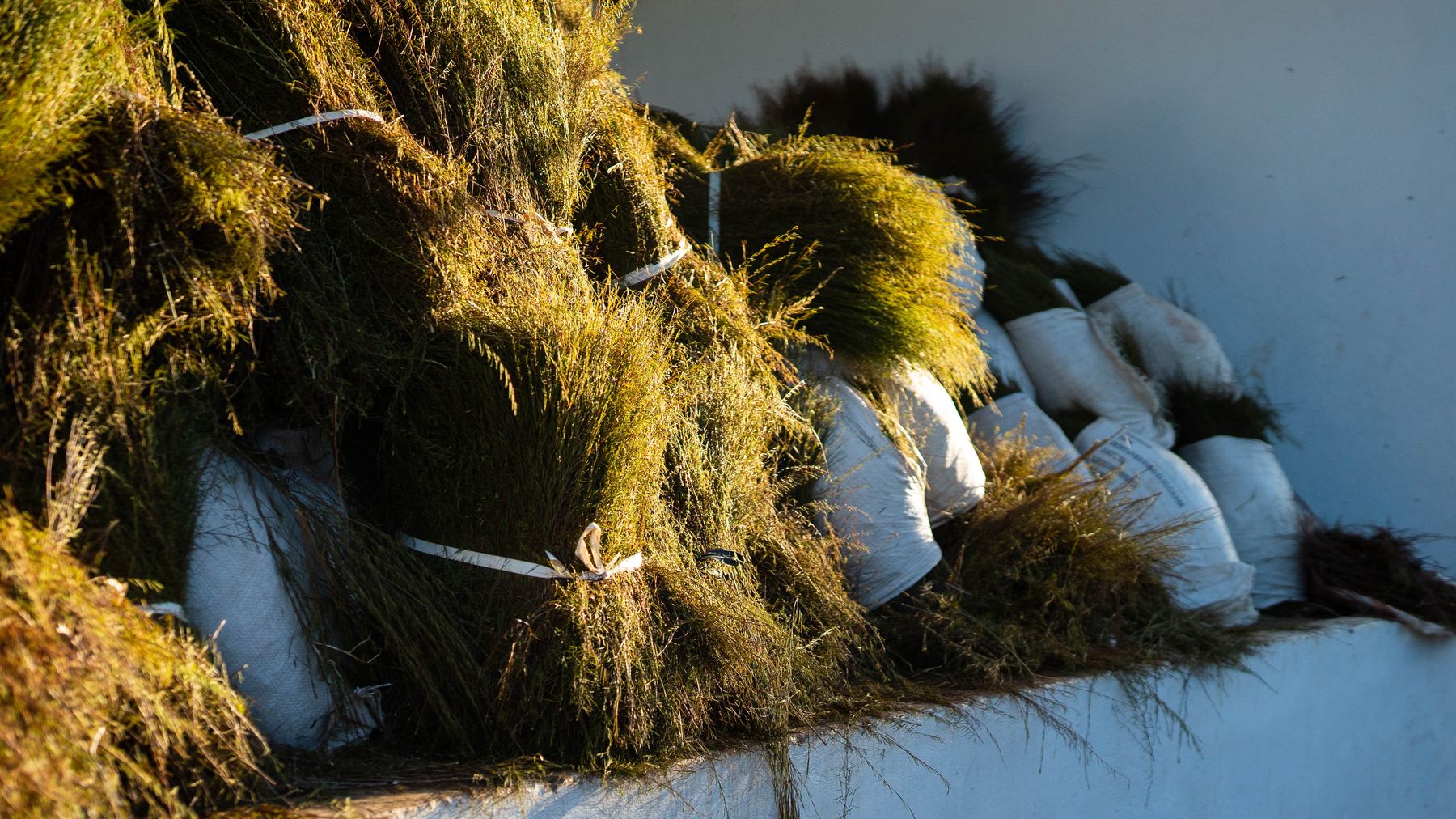
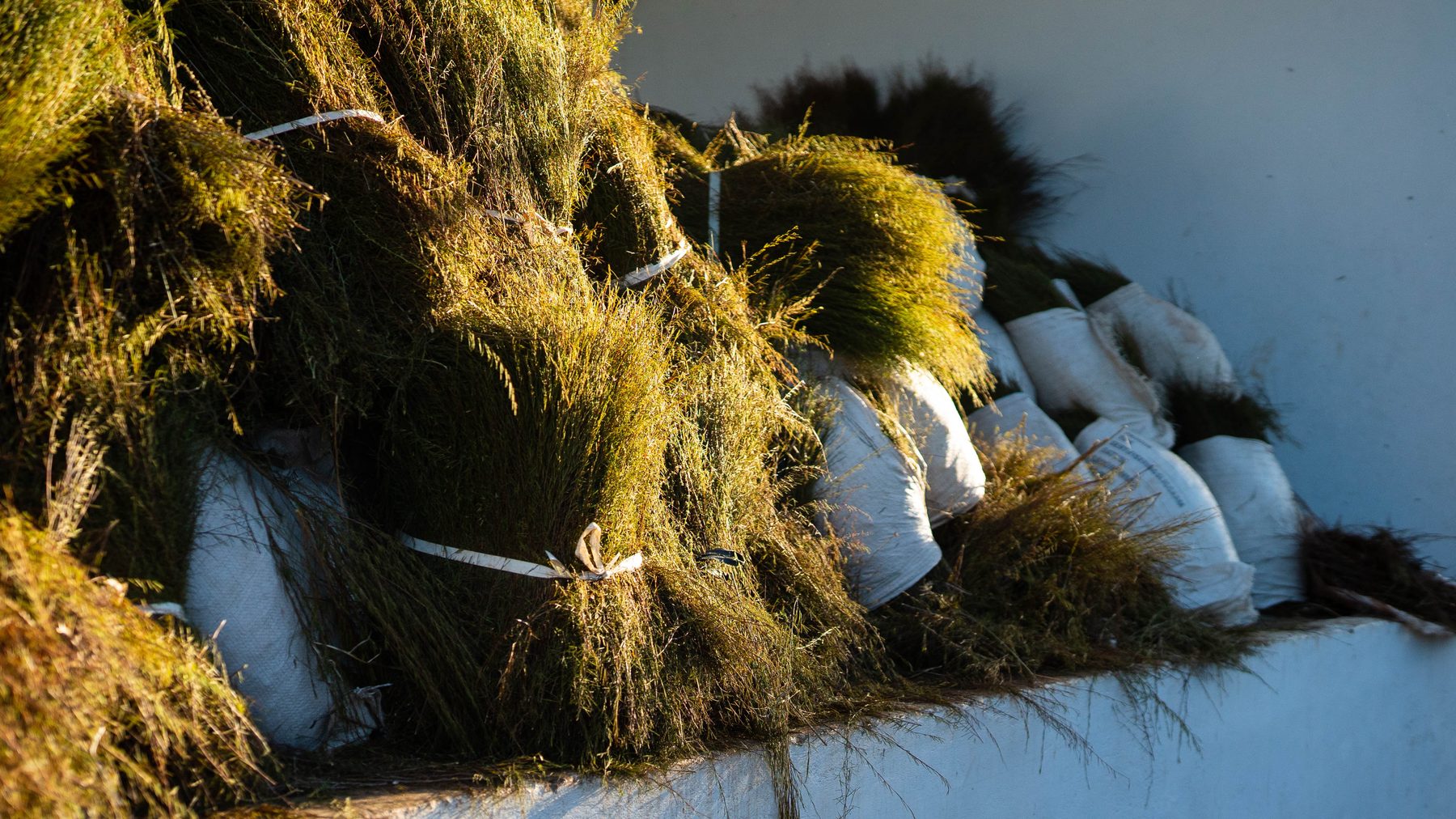
Sheaves arrive at the court as whole branches. A cutter chops them to a short length and the cut material is bruised and moistened. The cut length set here becomes one of the grading factors later; the bruising is what makes everything else possible, because an intact leaf keeps its phenolic compounds and its enzymes in separate compartments. Breaking the cell walls lets them meet, with water present and oxygen from the air. Processors describe the step in their own terms, and one names its cut-length range and its watering and airing before the heap; the details differ between courts.
What the plant's enzymes do
Rooibos trade language says the leaf is fermented. No yeast or culture is added and nothing alcoholic happens; the change is an oxidation carried out by enzymes naturally present in the plant, as the Council itself describes it. A 2019 controlled study in a plant matrix supports the participation of these endogenous enzymes and followed the reaction over time. The compounds that change most conspicuously are the dihydrochalcones aspalathin and nothofagin, which decline and transform; a 2017 analytical paper tracked aspalathin and eriodictyol-glucoside isomers as markers of the change. Flavanone intermediates form, further oxidation products follow, and among them are the compounds behind the red-brown colour and the familiar aroma.
Two cautions keep the diagram honest. Aspalathin does not convert through a single arrow into one flavone; the scheme is simplified, shows no stoichiometry and names no single product. And what is measured in a model solution does not automatically describe intact plant material, where structure, moisture and oxygen access vary through a heap. Claims about a specific enzyme need their own evidence, and none is made here.
How long: one processor's example, one laboratory's range
Four things move the reaction: moisture, oxygen, temperature and time. The industry's descriptions speak of an overnight heap, and Carmién publishes that at its own facility the watered and aired material lies in heaps for 10 to 14 hours before drying. That is one named operation's example; another court, another day or another lot may differ, and no universal timer follows from it. The 2019 study investigated reaction kinetics at 37 °C to 50 °C, which are that study's experimental conditions and not a recommended operating range for any court or factory. Rooibos is not honeybush, and no temperature from honeybush processing is borrowed here.
Three clocks run at once and should be recorded separately: the oxidation time in the heap, the total time since the leaf was cut in the field, and the drying time that follows. A duration quoted without the moisture and temperature it ran at is not a process description; it is a number. The court manager judges the end of the heap by colour and aroma, which is a decision, not a recipe, and this library states no setting as the right one.

Drying: evaporation from a layer
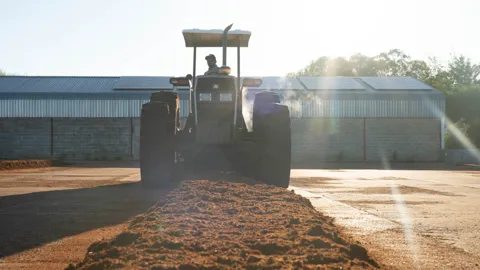
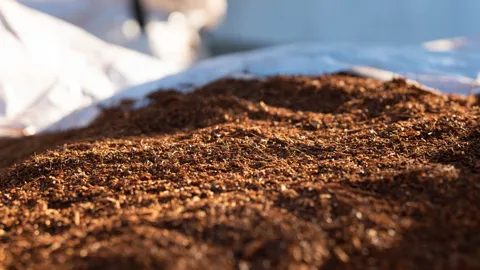
Drying removes water by heat and mass transfer. Energy comes from the sun on the court or from a dryer; moving air carries vapour away, and the drier the air the faster it goes; layer depth decides how far the inside is from the surface; turning brings the wet layer up; weather decides the rest. Red rooibos commonly follows the heap with sun drying on the court. The surface dries first, which is why a lot is judged on measured moisture and water activity, not on how it looks or feels. Storage and packaging can let moisture back in; a 2024 study of green rooibos in storage reports moisture uptake and changing water activity, a reason to measure both at release and again later.
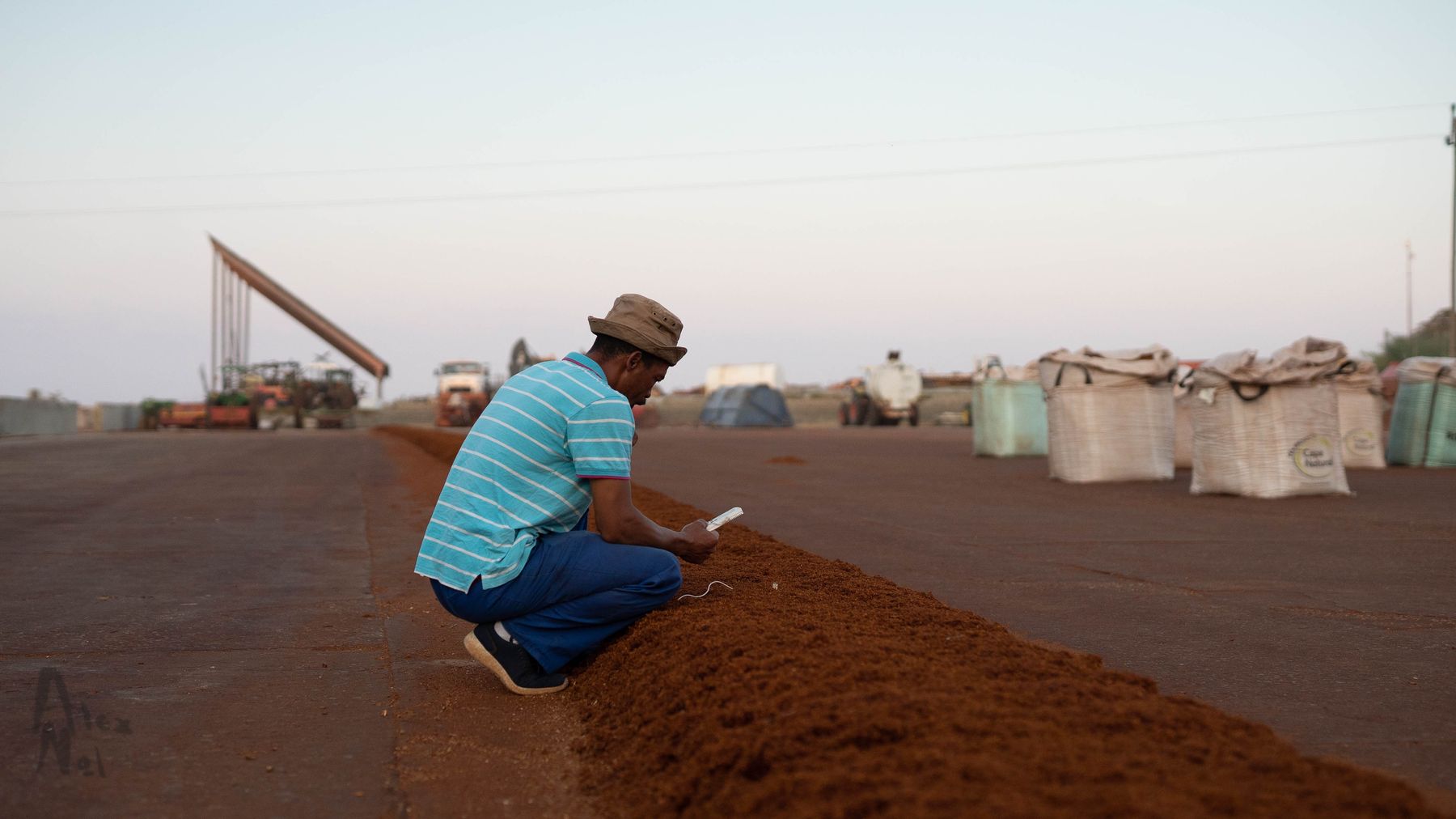
Four kinds of drying that must not share one number
- Raw leaf after the heap
- Red rooibos spread on the court to dry in the sun after oxidation. Brings moisture down for storage; the moisture reached is a measurement for the lot record, not a published constant.
- Rapid drying for green
- For green rooibos the bruised material is dried immediately so that oxidation does not run. One processor describes a heated fluid-bed dryer and a low moisture target; the protected name's single document sets a stricter moisture criterion for green than for oxidised product.
- Re-drying after steam
- Secondary processing pasteurises with steam and then dries again. One processor publishes its steam setting; that is its line's setting, not a product-core temperature and not a universal safe process, so it is not restated here.
- Spray-drying an extract
- An extract is a different product made by extraction and then spray-dried into a powder with its own moisture, solubility and shelf-life questions. Nothing about leaf drying transfers to it.
Drying is not a validated pathogen kill step. Raw rooibos carries a microbial load, and a dry product still needs validated controls; that is why pasteurising is a separate step with its own records and why a processor's steam setting is its own validated control, not something a reader can transfer to another line. A dry-looking heap is not a safe one by appearance.
What to ask about a lot's processing
- What cut length was set, and how was the material bruised and moistened before the heap?
- How long did this lot lie in the heap, and how was the end point judged?
- What moisture and water activity were measured before storage, by what method?
- For green: how soon after cutting was it dried, and to what moisture?
- Was the lot pasteurised and re-dried, where, and what records exist for that run?
The types and processing page draws the whole branch from cutter to packed lot; this chapter is the chemistry and the clocks behind two of its steps. Return to the supply chain to see where they sit.
Sources and notes for this page
The enzymatic account follows the Council and two peer-reviewed papers read only as indexed abstracts (2019 and 2017), so their findings are summarised at the level the abstracts support and no enzyme is named beyond them. The heap duration is Carmién's own published description of its facility and is not a standard. The microbial reason for a separate pasteurising step follows the 2014 review. Moisture criteria for the protected name come from the EU single document. Green rooibos storage behaviour follows a 2024 paper read as an indexed excerpt.
- SA Rooibos Council, Frequently asked questions, retrieved 2026-10-21.
- Carmién, Rooibos production and processing, retrieved 2026-10-21.
- Rooibos Ltd, About rooibos, retrieved 2026-10-20.
- Phenolic composition during simulated fermentation, 2019, abstract or excerpt read through a search index 2026-10-21; the document itself was not retrieved.
- Improved HPLC method for rooibos fermentation changes, 2017, abstract or excerpt read through a search index 2026-10-21; the document itself was not retrieved.
- Gouws, Hartel and van Wyk, 2014, retrieved 2026-10-20.
- Green rooibos sensory tools and storage, 2024, abstract or excerpt read through a search index 2026-10-21; the document itself was not retrieved.
- EU Implementing Regulation 2021/865, Rooibos / Red Bush PDO, retrieved 2026-10-20.
How sources are chosen and read is explained on the Sources and methodology page.